Product Catalog Agent·Aug 16, 2026·9 min read
Should You Hire a Catalog Specialist — or Automate SKU Onboarding with AI?

Daniel Emaasit
CEO, Logistify AI
TLDR
Automate SKU onboarding when supplier volume is moderate to high, data quality varies by supplier, or you publish to several channels; hire a catalog specialist when the work needs deep product knowledge or ongoing negotiation with suppliers over data quality. A 'Catalog Specialist' job posting is a specific signal. The company has enough new SKUs arriving from suppliers that someone's nearly full time is consumed by normalizing, deduplicating, and publishing product data — and they've decided to make it official. The economics of that hire are worth running before the offer goes out. A fully-loaded catalog specialist costs $55K–$75K/year. The work they do — extract supplier files, normalize fields, deduplicate against existing records, map to channel schemas — is the same Extract → Match → Normalize → Enrich → Publish workflow that AI now handles at a fraction of that unit cost. This post walks through where the math tips each way.
What a 'Catalog Specialist' Job Posting Actually Tells You
There are currently over 1,000 job postings in the U.S. under titles like 'Catalog Specialist,' 'Product Data Specialist,' 'Ecommerce Listing Specialist,' and 'Product Information Specialist.' The companies posting them are not tech startups. They are real distributors and product companies: Radwell International, Lonestar Electric Supply, Step2, Z1 Motorsports, Fastenal.
When a company posts one of these roles, three things are already true at once: they have the problem, they are spending money on it, and you know roughly what they are willing to pay. That makes the job board one of the clearest demand signals in product data operations — much clearer than cold-emailing random Shopify stores and hoping the timing is right.
The job descriptions are worth reading. They tend to say things like 'maintain product data accuracy across multiple channels,' 'work with suppliers to obtain product specifications and images,' and 'upload and format product listings for Amazon, Walmart, and our website.' That is the work. Described from the other side of the hiring decision.
What the Work Actually Involves
The hard part of catalog management is not writing product descriptions. ChatGPT can write a product description. Amazon's own Seller Central generates listing content automatically. That piece is increasingly commoditized.
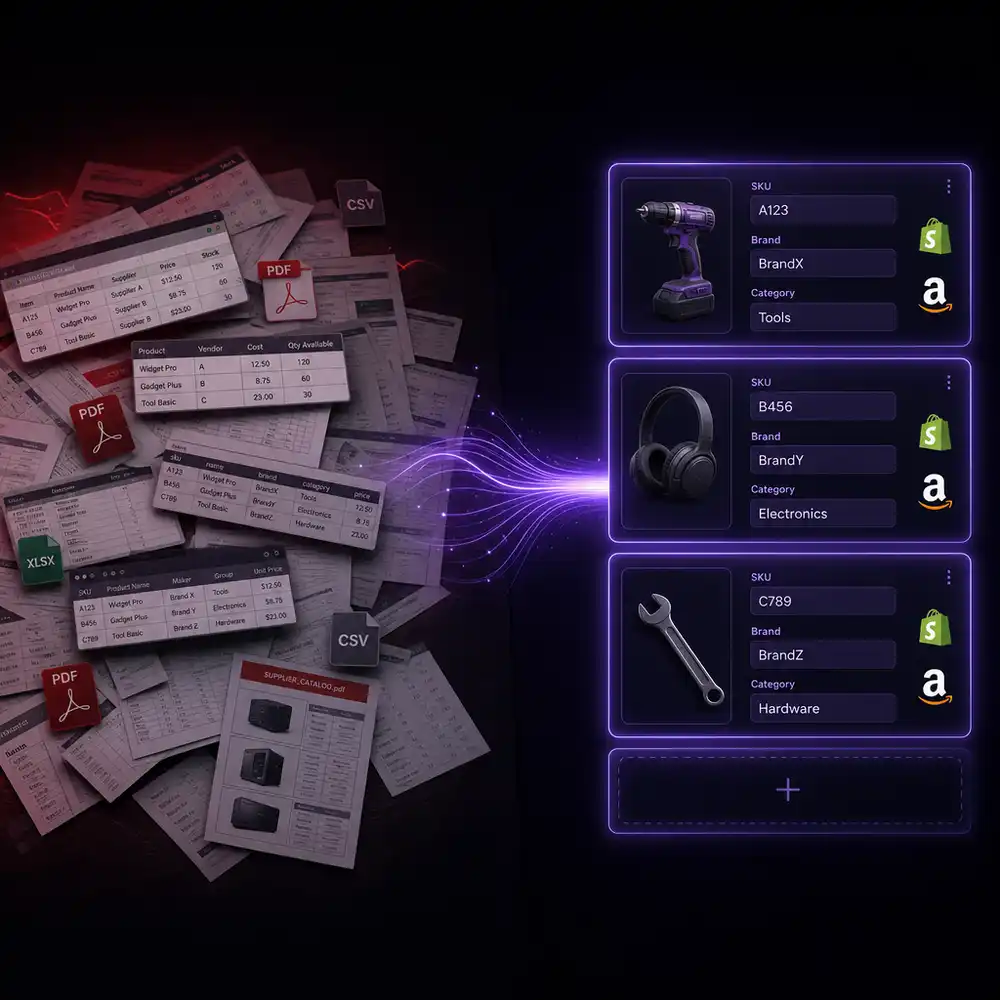
The genuinely difficult part is everything that happens before a description can be written. Consider a realistic example: a distributor signs a new supplier with 800 products. The supplier sends three files.
- SupplierCatalog_Q1_FINAL.xlsx — 800 rows, 12 columns, part numbers in the supplier's internal format
- PriceList_v3.csv — 840 rows (the extra 40 are discontinued SKUs the supplier forgot to flag)
- ProductImages.zip — 900 files, named by the supplier's internal SKU system, which does not match the catalog part numbers
None of these files agree with each other exactly. The distributor's Shopify template needs 47 fields; the supplier provided 12. Amazon's Product Type Definition API requires a different set of required attributes depending on the product category. Walmart's item setup has its own schema. Google Merchant Center needs yet another structured format.
Before a single product goes live, someone has to cross-reference the three source files and resolve the conflicts, normalize manufacturer names and part numbers against what is already in the catalog, identify and flag the rows that look like duplicates of existing SKUs, map each product into the distributor's category taxonomy, fill in the 35 missing required fields, resize and rename 900 images to match the SKU format, validate completeness, and publish to Shopify, Amazon, and Walmart separately because the schemas differ.
At a realistic pace, that is 6–10 minutes per SKU for a capable person when the source data is reasonably clean. At 800 SKUs, that is 80–130 hours before the first product is listed. Two to three weeks of one person's time, for a single supplier.
The Economics of the Hire
ZipRecruiter currently puts U.S. Product Data Specialist compensation at roughly $27/hour, about $56,600/year in base wages. Actual current postings range from $52K to $69K base, with contract positions at $35–$40/hour. Fully loaded — benefits, payroll taxes, equipment, onboarding, management overhead — the realistic annual cost lands between $55K and $75K.
At a reasonable pace, one catalog specialist can process roughly 80–120 new SKUs per day when the source data is clean, or 30–50 when it is not. For a distributor adding two or three new suppliers per quarter, that may be enough headroom. For one adding two or three per month — which is common at the $20M–$100M revenue level — it will not be.
There is also a volume ceiling to consider. The role has a hard throughput limit that scales with headcount, not with efficiency. Adding a second person doubles throughput but also doubles cost. That linear scaling is fine when the problem is linear. When supplier onboarding volume spikes — new category launch, platform expansion, acquisition — the team is suddenly underwater with no way to absorb the peak without hiring ahead of it.
What 'Managed SKU Onboarding' Means — and Why It's Not a PIM
Further reading
The Coordination Tax: The $1.6 Trillion Cost of Running Supply Chain on Human Hands
The CEO's thesis on why every manual handoff in your supply chain is a hidden tax — and why AI Agents are the only way to eliminate it.
Read the memoWhen people hear 'automate your catalog,' they often assume the answer is a PIM: Salsify, Akeneo, inriver, Pimcore. These are legitimate tools and many large distributors rely on them. But a PIM is software. It gives you a place to store and centrally manage product data. You still have to put the data in, normalize it, deduplicate it, map it, and push it out to channels. The PIM does not do that work. You still need someone to operate it — often a more senior person than the catalog specialist, because PIM systems require ongoing configuration.
Logistify provides managed SKU onboarding as a service. The completed work is the deliverable. Send us the supplier files; get back clean, validated, channel-ready products already published to your Shopify, Amazon, and Walmart storefronts. Our service runs the extraction, normalization, deduplication, category mapping, image processing, channel formatting, and publishing pipeline. Human reviewers handle the decisions that genuinely require judgment. The output is products in your systems, not a tool you learn to use.
That distinction matters when evaluating the hire vs. automate decision because they are solving different problems. A PIM hire gives you capacity you then have to operate. A managed service gives you output you do not have to staff.
The Comparison: Hire vs. Managed AI Service
| Internal catalog specialist | Offshore BPO | PIM software | Managed AI service | |
|---|---|---|---|---|
| Annual cost | $55K–$75K fully loaded | $7–$15/hr per head | $30K–$150K/yr license + ops | $24K–$60K/yr (managed) |
| Throughput ceiling | 80–120 SKUs/day per person | Manual — scales with headcount | Unlimited storage; ops bottleneck | High throughput; scales with volume |
| Source file handling | Yes — judgment-based | Yes — slow, error-prone | No — you import yourself | Yes — extract, normalize, map |
| Channel publishing | Manual per channel | Manual per channel | Yes — requires configuration | Yes — automated per channel schema |
| Duplicate detection | Depends on person | Rarely systematic | Some — requires setup | Yes — systematic across existing catalog |
| Institutional knowledge | Builds over time | Often lost on turnover | In the PIM config | Captured in taxonomy and alias maps |
| Surge capacity | Hire ahead or fall behind | Ramp time required | Tool doesn't help with ops | Absorbs volume spikes without hiring |
What AI Handles Well — and What Still Needs a Person
A managed AI service does not mean fully automated. The realistic division of labor, for most distributor catalogs, looks like this.
What AI handles reliably
- Cross-referencing multiple supplier files and building a unified source record
- Normalizing manufacturer names, part numbers, units of measure, and pack sizes against a consistent format
- Identifying likely duplicate SKUs against the existing catalog using part number, UPC, and description similarity
- Mapping products to category taxonomies where prior examples exist
- Filling missing fields where the source data contains the information in a different format or column
- Formatting records to Amazon Product Type Definition, Walmart item setup, Shopify, and Google Merchant Center schemas
- Resizing and renaming product images to match the SKU format
- Publishing approved products via API to connected channels
What still needs human judgment
- Deciding between two plausible category mappings when the product is ambiguous
- Resolving whether a near-duplicate is the same product or a genuine variant (different color, pack size, compliance spec)
- Approving products with incomplete required fields before they go live
- Supplier escalations when the source data is genuinely missing required information
- Any decision with a customer-facing consequence that the rules cannot resolve
At volume, the human portion is roughly 10–20% of the total SKU count. The rest moves through the automated pipeline without a reviewer touching it. For established suppliers whose file formats are already mapped, exception rates fall further — often below 5%.
When Hiring Still Makes Sense
This is not a post arguing against hiring. For some operations, a dedicated catalog specialist is the right answer.
If your catalog work requires deep product knowledge — technical specifications, regulatory attributes, compatibility data that a generalist cannot evaluate — a specialist with domain expertise makes sense. If your supplier relationships involve ongoing negotiation over data quality standards, having someone internal who can push back on suppliers effectively has real value. If the volume is genuinely low and stable (fewer than 200 new SKUs per month from predictable suppliers), the economics may not tip toward automation.
The clearer case for automation is when volume is moderate to high, source data quality varies widely across suppliers, you publish to multiple channels with different schema requirements, or you want to absorb supplier growth without proportional headcount growth. Any combination of those four factors tends to make the managed service more cost-effective, usually by the second or third supplier onboarding cycle.
The Question Worth Running Before the Offer Goes Out
Most hiring decisions for catalog roles happen because the problem is visible and the solution (hire someone) is the obvious move. That is a reasonable default. But it is worth running one number before the offer letter goes out:
"How many new SKUs per month are we onboarding across all suppliers, and what is our current cost per SKU to publish across all channels?"
If you do not know the number, that is useful information on its own. It usually means the work is distributed across several people's time and not tracked as a discrete cost center — which is common, and which means the true cost is higher than it appears on the org chart.
At $55K/year fully loaded and 80 SKUs/day capacity, the internal cost is roughly $3.50–$4.50 per published SKU when the source data is clean. When it is not, that number climbs. A managed service that delivers clean, published SKUs at $1.50–$3.00 per SKU changes the math significantly — not because it replaces all judgment, but because it removes the 80% of the workflow that does not require it.
Send us a sample. See the cleanup for yourself
Send us a small sample of your supplier spreadsheet or export. We will clean it up for free and send back a clean, channel-ready sheet so you can see the results on your own data.
Frequently Asked Questions
Send us a sample. See the cleanup for yourself
Send us a small sample of your supplier spreadsheet or export. We will clean it up for free and send back a clean, channel-ready sheet so you can see the results on your own data.