From the CEO·Mar 5, 2026·6 min read
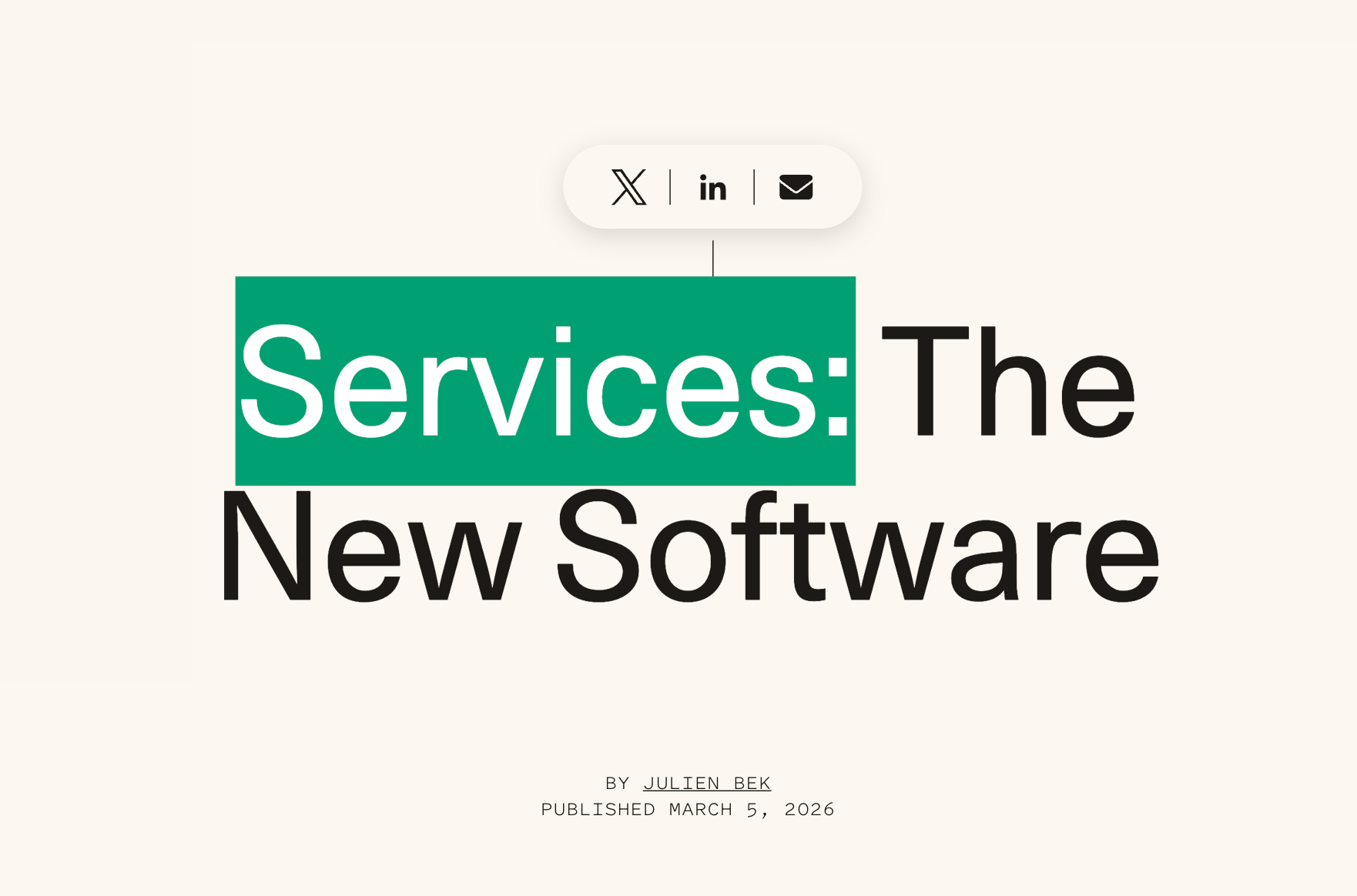
Services: The New Software: Why Logistify AI is an AI Services Firm.

Daniel Emaasit
Co-Founder & CEO, Logistify AI
TLDR
The next generation of AI companies will sell finished work, not just software capabilities. Companies already spend far more on services than software, and AI can now perform many of the workflows people are paid to run. Logistify AI applies this model to product catalog operations: customers send messy supplier files and receive clean, validated, ecommerce-ready product records back. The software powers the delivery, but the outcome is the product.
The services pool already exists
Earlier this year, Sequoia Capital partner Julien Bek published an essay called “Services: The New Software.” It quietly redrew the map for how I think about building an AI company, because most founders have the business model backwards.
The core claim is simple: for every dollar a company spends on software, it spends about six dollars on services. That pool of services money already exists. Nobody has to invent the demand, pitch a new category, or convince a buyer that they have a problem. The work is being paid for today by real companies with real budgets.
Software sells a capability. Services deliver the work.
Software struggles to capture that services budget for a reason. A tool sells a capability. The customer buys it and then still has to do the work.
Consider a wholesale distributor onboarding new products from a supplier. The supplier sends product data in an Excel spreadsheet. The distributor buys a tool to help clean the data before pushing it to an ERP such as NetSuite or an ecommerce site such as Shopify. Someone still has to clean the data, enter the products, reconcile missing columns, and resolve exceptions. The software is the accelerator. The human is still the engine.
That is why most of the budget ends up not on the tool, but on running the tool. The dashboard is not the outcome. The clean product catalog is.
AI changes what the product can be
The bet is that AI flips this relationship. When a system can not just accelerate the work but do the work, the product becomes the outcome. You are no longer selling a dashboard that the customer powers with their own people. You are selling the finished job.
That changes pricing, sales, and competition. The autopilot captures the work budget, not just the software budget.
Pricing becomes a share of an existing budget
Pricing stops being a per-seat number that you have to justify. It becomes a slice of a budget that already exists.
In the catalog example, the distributor already pays someone to turn messy supplier data into a clean catalog. If that work is outsourced to Logistify, the price sits alongside an existing line item. The buyer is not deciding whether to adopt a new technology. They are deciding whether to change who delivers work they already need.
The first sale is a project, not a platform migration
Sales gets shorter for the same reason. A SaaS tool has to be demoed, piloted, and adopted by people who must change how they work. An outcome-based service has to deliver the thing the customer was already paying for, ideally better and cheaper.
The first deal becomes a project, not a platform migration. The customer can start with a real supplier file and judge the finished output. There is less organizational change to manage and less trust to ask for upfront.
Further reading
The Coordination Tax: The $1.6 Trillion Cost of Running Supply Chain on Human Hands
The CEO's thesis on why every manual handoff in your supply chain is a hidden tax — and why AI Agents are the only way to eliminate it.
Read the memoThe moat is in the customer's operational knowledge
Software moats often come from switching costs, network effects, and distribution. A services moat is different. It comes from learning the customer's data, suppliers, file formats, units of measure, exceptions, and the hundred tiny rules that make their catalog messy in a way nobody else's is.
That knowledge compounds with every project. The first job shows you the mess. The fifth makes you the obvious choice to keep running it. Delivery creates the operational context that generic software cannot obtain from a blank implementation.
This is still a software company
This is not a retreat from software or a leap into a low-margin services business. It is a software company that sells its work as the product. The margins come from the software underneath. The trust and the entry point come from doing the job.
The buyer sees a service they understand. The cost structure underneath is software-like. That combination is the important part: software economics supporting a service experience.
We are living this at Logistify AI
We made the deliberate decision to build on the outcome side of this thesis. Our flagship product is not a tool you buy and then operate. It is catalog operations: send us the messy files from your suppliers and ERP, and we hand back a clean, complete, ecommerce-ready catalog.
AI does the heavy lifting on matching part numbers, fixing units, finding duplicates, and filling missing fields. A human reviews the unusual cases before anything is published. The work is the product.
Sell the outcome, not the tool
A supplier line might read:
"3M 7100135632 DISC 5IN 80G PK25"
That is a real product, but it is not buyable in that form. There is no clear title, brand field, size, or pack quantity. It takes a person with product knowledge, or an AI service trained on the workflow, to turn it into something a customer can actually purchase: a 3M Cubitron II sanding disc, 5 inch, 80+ grit, pack of 25, with every required attribute filled in and ready for Shopify or the ERP.
That is the work companies are paying people to do right now, often slowly and inconsistently. It is exactly the kind of work an AI service should own.
Which side of the thesis are you on?
Ask what you sell. If you sell software and hope the customer does the work, you are racing the model. Every time the frontier model gets better, a piece of your value can evaporate because the customer can increasingly do that part themselves.
If you sell the finished work, the model getting better helps you. Your cost drops, your throughput rises, and the outcome you deliver stays the same.
Sequoia's essay is not a prediction about a single company. It is a description of where the industry is pointed. For anyone building right now, the question is straightforward: are you selling a tool someone has to run, or the finished job they already pay for?
The next big AI company, I am increasingly convinced, sells the finished job.
See what AI can do with your messy product data
Send us a small sample of your supplier spreadsheet or export. We will clean it up for free and send back a clean, channel-ready sheet so you can see the outcome before moving forward.
Frequently Asked Questions
Sell the outcome. Not the tool.
Send us a small sample of your messy product data. We will clean it up for free and show you what an AI service can deliver on your actual files.