Dock Scheduling·Mar 15, 2026·12 min read
What Is Dock Scheduling? The Definitive Guide

Daniel Emaasit
CEO, Logistify AI
TLDR
Dock scheduling is the process of coordinating which trucks load or unload at which dock doors, and when. Done well, it eliminates wait times, reduces detention costs, and gives warehouses predictable labor plans. Done poorly — or not at all — it creates a cascade of delays that ripple from the loading dock to the end customer.
A Tuesday Morning at Dock 7
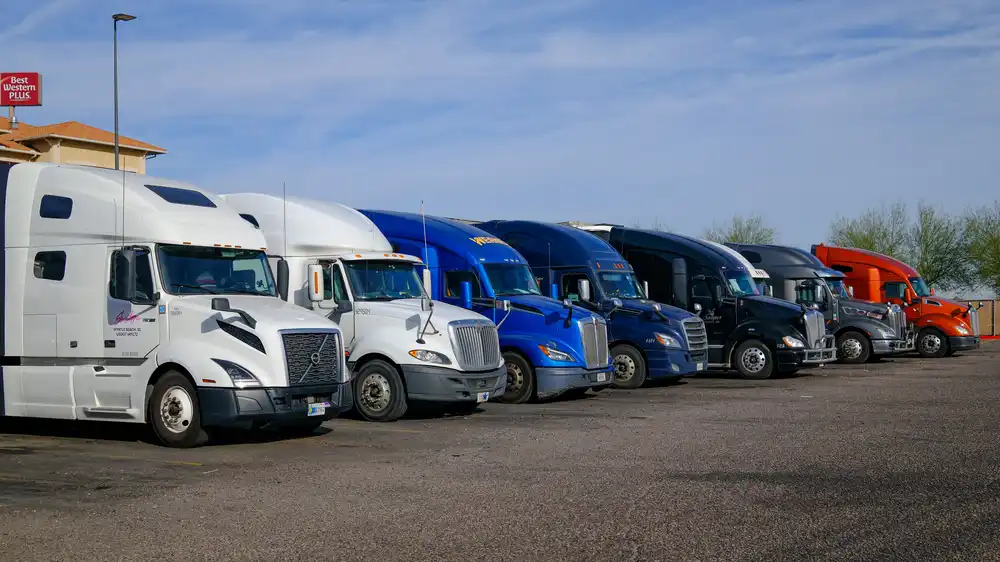
It is 6:45 a.m. and three trucks are already idling in the yard. The dock coordinator's phone has not stopped buzzing since 5:30. A carrier who was supposed to arrive at 7:00 showed up an hour early and is blocking the only trailer spot near Dock 4. Another carrier — the one carrying temperature-sensitive pharmaceuticals — has not confirmed whether they are coming at all. A third driver called in asking if he could "just swing by around lunchtime" instead of his 9:00 slot because his previous stop ran long.
Inside the warehouse, the receiving crew is standing around because the first inbound of the day is not here yet. The forklift operator who was scheduled for outbound loading has been pulled to help unload the early arrival, which means the outbound shipment to the distribution center is now behind schedule. The warehouse manager is on a call with a customer trying to explain why yesterday's order has not left the building.
None of this chaos is unusual. This is what happens every day at warehouses that do not have a functioning dock scheduling process. The trucks are there. The freight is there. The people are there. What is missing is coordination — a shared, structured plan for who shows up where and when.
That is the problem dock scheduling exists to solve.

What Is Dock Scheduling?
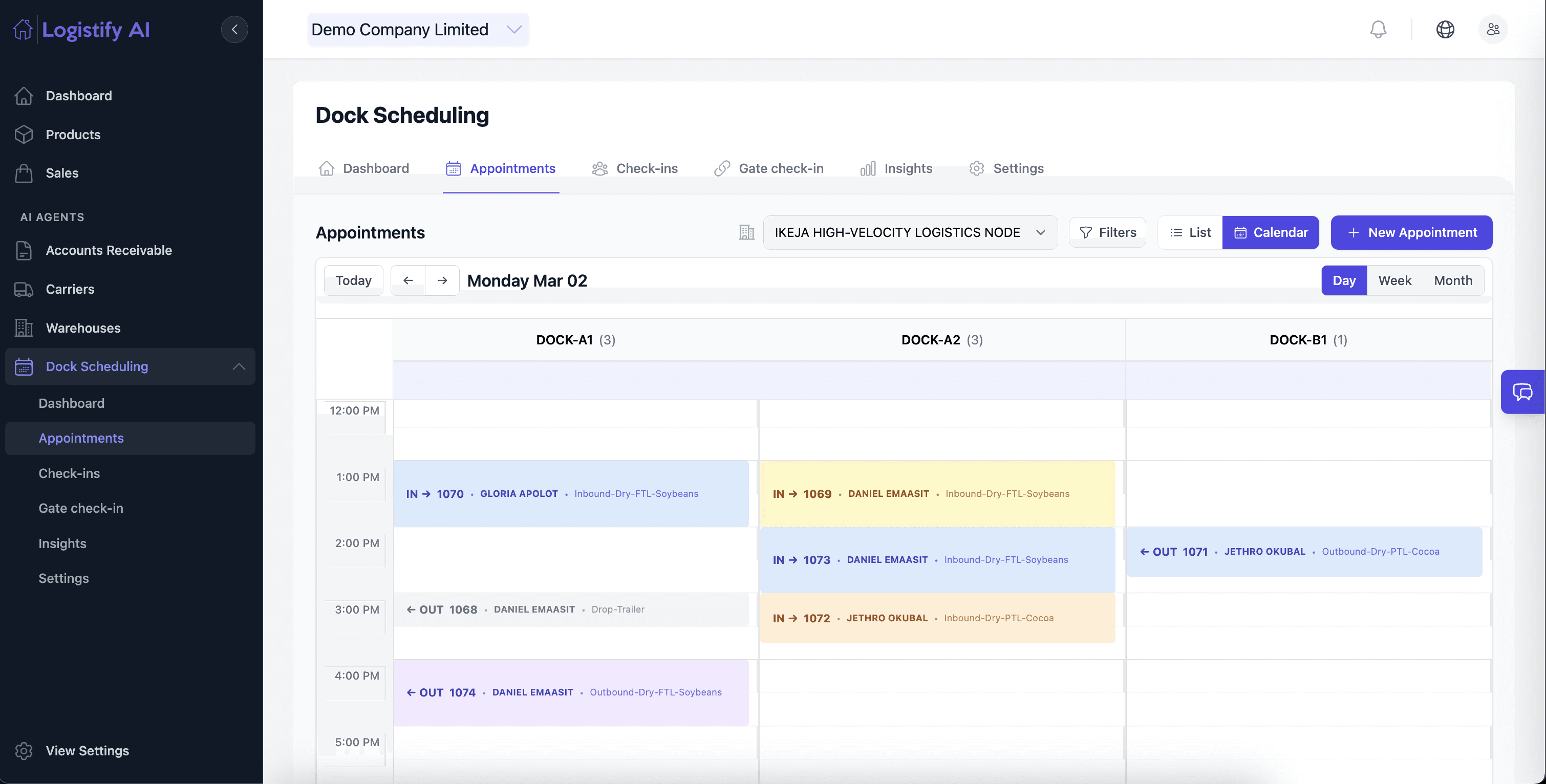
Dock scheduling is the practice of assigning specific time windows to inbound and outbound trucks at a warehouse or distribution center's loading docks. At its simplest, it answers three questions: Which truck? Which dock door? What time?
A "dock" in this context is a loading dock — the physical bay where a truck backs up to a warehouse wall so that goods can be loaded onto or unloaded from the trailer. Most warehouses have multiple dock doors, and the number of doors directly limits how many trucks can be serviced at the same time.
"Scheduling" means assigning appointments — agreed-upon arrival times — so that trucks do not all show up at once, and so that the warehouse can plan labor, equipment, and staging space in advance. Without a schedule, docks operate on a first-come-first-served basis, which almost always leads to congestion, idle trucks, and wasted labor.
The stakeholders in dock scheduling include warehouse operators (who manage the dock doors and the labor), carriers and drivers (who need to know when and where to show up), shipping and receiving coordinators (who match appointments to purchase orders and shipments), and sometimes third-party logistics providers or brokers who sit between the shipper and the carrier.
The Core Components of Dock Scheduling
Dock scheduling involves several interlocking components. Understanding each one is important because the system only works when all the pieces are aligned.
Dock Doors
Dock doors are the physical constraint around which everything else revolves. A facility might have 10 doors, 50 doors, or 200. Some doors may be designated for inbound only, outbound only, or both. Some may be equipped for refrigerated trailers or hazmat loads. The number and type of available doors sets the upper limit on throughput at any given time.
Time Slots
Time slots are the windows during which a truck is expected to arrive and be serviced. Slots can be as short as 15 minutes for a quick drop-trailer swap or as long as several hours for a complex live-unload with multiple SKUs. The length and granularity of time slots vary by facility and by the type of freight being handled.
Appointment Types
Not all dock appointments are the same. The most common types include:
- Live load / live unload — The driver stays with the truck while it is loaded or unloaded. This is the most time-sensitive type because the driver and truck are both occupied for the entire duration.
- Drop trailer — The carrier drops a loaded or empty trailer at the dock and leaves. The warehouse loads or unloads it on their own schedule and the carrier picks it up later. This decouples the driver's time from the warehouse's time.
- Cross-dock — Freight arrives inbound and is immediately transferred to an outbound truck with minimal or no storage. Cross-dock operations require tight scheduling because the inbound and outbound appointments must be closely synchronized.
Inbound vs. Outbound
Inbound scheduling covers trucks arriving to deliver product to the warehouse — replenishment from suppliers, returns, raw materials for manufacturing. Outbound scheduling covers trucks arriving to pick up product — orders going to retailers, distributors, or end customers. Many facilities manage these separately because the labor, equipment, and staging requirements are different.
Carrier Check-In
Check-in is the process of recording a driver's arrival and matching them to their appointment. In many facilities, this still happens at a guard shack with a clipboard. More modern operations use kiosks, text-based check-in, or geofencing that automatically detects when a truck enters the yard. The check-in process feeds the dock schedule with real-time status: who has arrived, who is late, and who is a no-show.
What Does Dock Scheduling Solve?
Dock scheduling exists because the alternative — no scheduling at all — is expensive, unpredictable, and frustrating for everyone involved. Here are the specific problems it addresses.
Coordination Chaos
Without appointments, trucks arrive whenever they want. This leads to yard congestion, drivers waiting for hours, and dock crews alternating between standing idle and being overwhelmed. A schedule transforms a chaotic free-for-all into a predictable flow.
Detention Costs
Detention is the charge a carrier levies when their truck and driver are kept waiting beyond a reasonable loading or unloading window — typically two hours. The American Transportation Research Institute (ATRI) estimates the U.S. trucking industry loses over $15 billion per year to detention. Dock scheduling directly reduces detention by spreading arrivals across the day and giving both parties a shared expectation of when service will happen.
Labor Planning
Warehouse labor is one of the largest operating costs for any distribution center. When the dock schedule is unpredictable, managers either overstaff (wasting money) or understaff (creating bottlenecks and overtime). A reliable schedule lets operations managers match crew size to expected volume hour by hour.
Carrier Relationships
Further reading
The Coordination Tax: The $1.6 Trillion Cost of Running Supply Chain on Human Hands
The CEO's thesis on why every manual handoff in your supply chain is a hidden tax — and why AI Agents are the only way to eliminate it.
Read the memoCarriers remember which facilities treat their drivers well and which ones make them wait for four hours in a parking lot. Facilities with smooth dock scheduling tend to get better rates, more reliable service, and priority treatment during peak season when capacity is tight.
Compliance and Audit Trails
Many industries — food, pharmaceuticals, chemicals — require documentation of when goods arrived and were received. A dock scheduling system creates an automatic log of appointment times, actual arrival times, and service durations. This data is valuable for regulatory compliance, carrier scorecards, and internal performance reviews.
What Dock Scheduling Cannot Solve
It would be dishonest to suggest that dock scheduling is a silver bullet. There are real limitations, and understanding them is important for setting realistic expectations.
Physical Capacity Limits
If a warehouse has 8 dock doors and needs to process 20 trucks per hour, no scheduling system will fix that. Scheduling optimizes the use of existing capacity — it does not create new capacity. Facilities that are genuinely constrained by physical infrastructure need capital investment, not better software.
Upstream Readiness Problems
A perfectly scheduled outbound appointment is useless if the order has not been picked, or if inventory is stuck in a QA hold, or if the packaging line is behind schedule. Dock scheduling coordinates the truck-side of operations; it does not fix problems that originate upstream in the warehouse or supply chain.
Poor Carrier Compliance
A schedule only works if carriers actually follow it. Some carriers chronically arrive early, late, or not at all. Dock scheduling provides the framework for accountability — scorecards, no-show tracking, penalty policies — but it cannot force a carrier to be on time. The cultural and operational change has to happen on both sides.
Bad Data Hygiene
If appointment data is entered incorrectly — wrong purchase order numbers, wrong carrier codes, mismatched door assignments — the schedule becomes unreliable. Garbage in, garbage out applies to dock scheduling just as it does to any system. The technology can validate and flag errors, but it cannot compensate for a process that does not value data accuracy.
How Dock Scheduling Has Evolved
Dock scheduling is not new. What has changed is how it is done.
In the earliest days, dock schedules lived on paper — a clipboard at the guard shack or a whiteboard in the shipping office. The dock supervisor knew the schedule because it was in their head, and if they were absent, nobody knew what was going on.
Spreadsheets were the next step. A shared Excel file or Google Sheet gave multiple people visibility into the schedule. This was an improvement, but spreadsheets have no conflict detection (two appointments can easily be booked for the same door at the same time), no notifications, and no audit trail.
Dedicated scheduling portals emerged in the 2000s and 2010s. These web-based tools let carriers self-book appointments, automated confirmation emails, and provided dashboards for dock managers. They solved the coordination problem but introduced a new one: carriers had to learn and use yet another portal, and many smaller carriers simply did not bother.
The current frontier is AI-powered automation. Instead of requiring carriers to log into a portal, AI-driven systems can accept appointment requests via the channels carriers already use — email, phone, SMS, WhatsApp — and handle the booking, rescheduling, and confirmation automatically. This removes the adoption barrier that has held back traditional scheduling portals.

Common Misconceptions About Dock Scheduling
Dock scheduling sits at the intersection of warehouse operations and transportation, and that means it is often misunderstood by people who only see one side of the equation. Here are the most common misconceptions.
"It is the same as a TMS."
A Transportation Management System (TMS) handles the movement of freight between locations — route planning, carrier selection, freight payment, tracking. Dock scheduling handles what happens when that freight arrives at the warehouse door. They are complementary systems, not substitutes. A TMS decides which carrier moves the load and when it should arrive. Dock scheduling decides which door it pulls up to and whether the warehouse is ready to handle it.
"Automation means no humans are needed."
Automation can eliminate much of the repetitive communication — the phone calls, the back-and-forth emails, the manual data entry — but it does not eliminate the need for human judgment. Exceptions happen constantly: a truck arrives with the wrong paperwork, a high-priority customer needs to jump the queue, a dock door breaks down mid-shift. Automation handles the routine so that people can focus on the exceptions.
"It only matters at large warehouses."
Any facility that receives or ships more than a handful of trucks per day benefits from dock scheduling. In fact, smaller facilities often benefit more because they have fewer dock doors and less margin for error. A large distribution center with 80 doors can absorb some inefficiency. A small warehouse with 4 doors cannot.
"Scheduling software fixes detention."
Scheduling software reduces detention by improving coordination, but detention has multiple causes — slow unloading crews, inventory not staged on time, carriers arriving outside their window. Software addresses the scheduling component of detention, but it cannot fix operational bottlenecks inside the warehouse or on the carrier side. Detention reduction requires process improvement across the board, not just better software.
How Dock Scheduling Connects to the Wider Warehouse
Dock scheduling does not operate in isolation. It touches — and is touched by — several other systems and processes in the warehouse and transportation ecosystem.
A Warehouse Management System (WMS) manages inventory, picking, packing, and put-away. The dock schedule feeds the WMS by telling it what inbound shipments to expect and when, and the WMS feeds the dock schedule by flagging when outbound orders are ready to ship.
A Transportation Management System (TMS) manages carrier selection, route optimization, and freight payment. The TMS typically creates the shipment, and the dock schedule assigns it a physical time and place at the warehouse.
Yard Management Systems (YMS) track trailers and containers once they enter the facility gate. If a truck checks in but all dock doors are occupied, yard management determines where that truck waits and in what order it moves to the dock. Dock scheduling and yard management are tightly coupled — you cannot optimize one without considering the other.
Labor management ties directly into the dock schedule. Knowing that 12 inbound trucks are expected between 6:00 a.m. and 10:00 a.m. lets operations managers staff the right number of receivers and forklift operators. Without that visibility, labor planning is guesswork.
Where Logistify AI Comes In
We built Logistify AI because we lived this problem. Our co-founders operated 3PL warehousing across 10 facilities and saw firsthand that the bottleneck was never the calendar — it was the communication around the calendar. Logistify AI is an AI-powered dock scheduling agent that handles appointment booking, rescheduling, confirmation, and exception management across the channels carriers actually use — email, phone, SMS, and WhatsApp. It does not replace your scheduling process; it automates the communication layer that makes that process work.
If your facility is still managing dock appointments through phone calls and spreadsheets, or if you have a scheduling portal that carriers are not adopting, reach out at daniel@logistify.ai.
Frequently Asked Questions
Ready to automate your supply chain?
Join manufacturers and distributors automating their operations with Logistify AI.