Industry Research·May 7, 2026·37 min read
ERP Software Comparison: The Definitive Guide for Manufacturers and Distributors in the USA (2026)

Daniel Emaasit
CEO, Logistify AI
TLDR
The best ERP for a manufacturer or distributor depends on revenue and manufacturing type: Odoo, SYSPRO or Business Central under $10M, NetSuite or Acumatica from $10M to $50M, Epicor, Infor or Dynamics 365 for complex mid-market manufacturing, and SAP or Oracle above $1B. Choosing an ERP is the most consequential software decision a manufacturer or distributor will make — and 73% of discrete manufacturing ERP projects fail to meet their stated objectives. This guide profiles all 12 major ERP platforms used in the USA, compares them by tier, pricing, and Gartner standing, and gives you a concrete framework for choosing the right one. It also covers the one problem that even the best ERP cannot solve: the coordination gap between your system of record and the real world.
Why This Comparison Matters in 2026
The ERP selection decision is unlike any other software purchase. Unlike a CRM or marketing tool that can be swapped in months, an ERP becomes the operating system of your business — touching every order, every inventory movement, every invoice, every financial report. Getting it wrong is extraordinarily expensive. The average failed ERP implementation costs $10.6 million. The average cost overrun in discrete manufacturing is 215% over budget. Only 25–30% of all ERP projects complete on time and within budget.
In 2026 the ERP market is both bigger and harder to choose from than it has ever been. The global ERP market is valued at $92.6 billion and growing at 13.8% CAGR, on track to reach $229.79 billion by 2032. The USA accounts for approximately $13.3 billion of that, or 34% of global spend. Cloud ERP now represents 70% of all new implementations. And every major vendor has embedded AI capabilities, from SAP's Joule platform with 2,500+ AI skills to Oracle's AI Agent Studio with 50+ embedded agents, which narrows the feature gap between platforms and makes the differences harder to evaluate.
What has not changed is the fundamental challenge: the ERP is a system of record. It captures what has already happened. The daily work of coordinating orders, shipments, payments, and supplier communications still happens between the ERP and the real world — in email inboxes, WhatsApp threads, paper documents, and phone calls. This guide covers both the ERP landscape and the gap that sits beyond it.
The ERP Landscape in 2026: What Gartner Found
Gartner's 2026 Magic Quadrant for Cloud ERP for Product-Centric Enterprises produced a striking result: for the first time in recent memory, there are no Challengers and no Visionaries — only Leaders and Niche Players. The market has polarized. The large platforms have extended their leads through AI investment and ecosystem scale, while the specialized mid-market and SMB vendors have carved out defensible positions in specific manufacturing niches.
The 2026 MQ Leaders are: SAP S/4HANA (SAP Cloud ERP), Oracle Fusion Cloud ERP, Microsoft Dynamics 365, Oracle NetSuite, Epicor Kinetic, Infor CloudSuite Industrial, and IFS Cloud. Oracle and Microsoft stand out as the two highest-rated Leaders by Gartner's analysis. IFS Cloud earned the unique distinction of being the only 2026 Gartner Customers' Choice — meaning it received the highest satisfaction ratings directly from its users among all evaluated vendors.
The Niche Players — Acumatica, SYSPRO, Plex, and Sage X3 — are not weak options. They are highly capable platforms for the specific segments they serve. The 'Niche' designation reflects market reach and breadth of coverage, not product quality.
How to Use This Comparison
This guide organizes ERP platforms into three tiers based on the revenue size of the businesses they are designed to serve. Understanding which tier applies to your business is the first and most important filter.
- Tier 1 — Enterprise (revenue >$500M): Platforms built for complex, global, multi-plant operations. SAP S/4HANA and Oracle Fusion Cloud ERP are the defining options. These are powerful, expensive, and require dedicated implementation resources. Do not evaluate these unless your business genuinely operates at enterprise scale.
- Tier 2 — Mid-Market ($25M–$500M): The richest and most competitive segment. Microsoft Dynamics 365, Oracle NetSuite, Epicor Kinetic, Infor CloudSuite Industrial, IFS Cloud, and Sage X3 all compete here — each with different strengths by manufacturing type and industry vertical.
- Tier 3 — SMB and Specialized ($5M–$100M): Platforms optimized for growing manufacturers and distributors who need genuine ERP capability without enterprise-grade complexity and cost. Acumatica, SYSPRO, Plex Smart Manufacturing Platform, and Odoo serve this tier.
Manufacturing type matters as much as company size. Discrete manufacturing (individual units assembled from components — electronics, industrial equipment, automotive parts) has different ERP requirements than process manufacturing (continuous production — food & beverage, chemicals, pharmaceuticals) or mixed-mode operations. Engineer-to-order (ETO) manufacturers — who design and build one-of-a-kind products per customer specification — have fundamentally different needs from make-to-stock (MTS) businesses running high-volume standardized production. The right ERP for one manufacturing type can be the wrong choice for another.
The Master Comparison Table
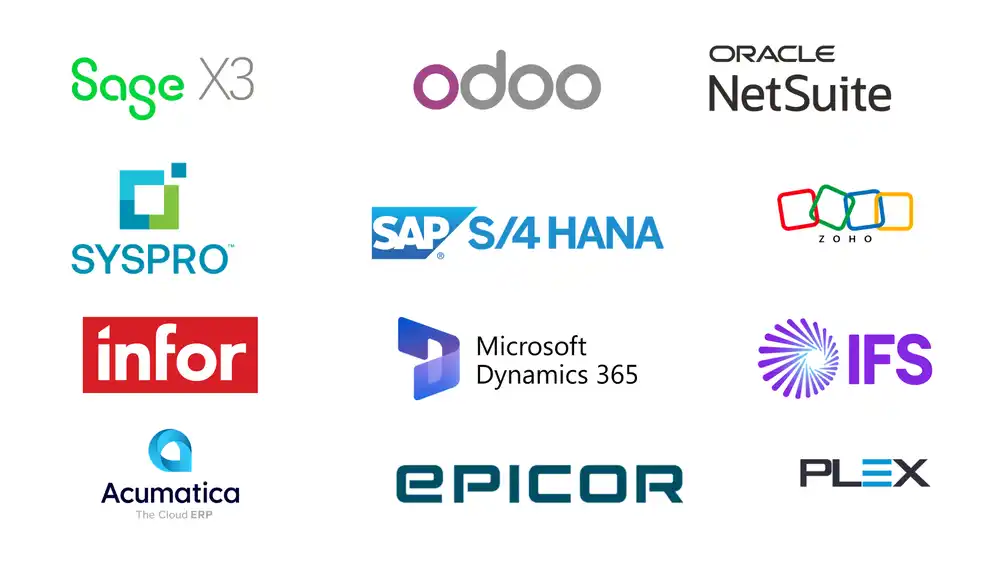
The following overview covers all 12 platforms across the key evaluation dimensions. Pricing shown is directional — actual costs depend heavily on user count, modules selected, and implementation partner rates.
- SAP S/4HANA (SAP Cloud ERP) | Enterprise | ~$180/user/mo (Public Cloud); $3,000–$5,000/mo (Private Cloud RISE) | Cloud & Private Cloud | Gartner Leader | Ideal for: Global manufacturers >$150M revenue; discrete and process manufacturing; M&A-track companies
- Oracle Fusion Cloud ERP | Enterprise | ~$300–$600/user/mo (estimated) | Cloud-only | Gartner Leader (highest Ability to Execute 2026) | Ideal for: $250M–$10B+ enterprises needing tight finance + manufacturing integration
- Microsoft Dynamics 365 SCM / Business Central | Mid-Market & SMB | D365 SCM: $75K–$350K/yr (Year 1); D365 BC: ~$70–$100/user/mo | Cloud, Hybrid, On-Premise | Gartner Leader | Ideal for: $5M–$1B manufacturers in the Microsoft ecosystem
- Oracle NetSuite | Mid-Market | ~$129/user/mo + base license; Year-1 typical $100K–$300K | Cloud-only | Gartner Leader | Ideal for: $5M–$300M fast-growing manufacturers and multi-entity distributors
- Epicor Kinetic | Mid-Market | ~$175–$250/user/mo; 5-year TCO $1M–$4M | Cloud & On-Premise | Gartner Leader | Ideal for: $10M–$500M discrete manufacturers; job shops; ETO
- Infor CloudSuite Industrial (SyteLine) | Mid-Market | Custom subscription; 5-year TCO $1M–$4M | Cloud (AWS) | Gartner Leader | Ideal for: $25M–$1B complex discrete manufacturers; ETO, MTO; aerospace, defense, automotive
- IFS Cloud | Mid-Market to Enterprise | Custom; upper mid-market to enterprise pricing | Cloud | Gartner Leader & 2026 Customers' Choice | Ideal for: $100M–$3B asset-intensive manufacturers; aerospace, defense, energy; project-based and ETO
- Sage X3 | Mid-Market | ~$150–$250/user/mo | Cloud & On-Premise | Gartner Niche Player | Ideal for: $10M–$200M manufacturers in food & beverage, chemicals, pharma; compliance-sensitive distribution
- Acumatica Manufacturing Edition | SMB | ~$2,000–$5,000/mo base; 5-year TCO $500K–$2M | Cloud-only | Gartner Niche Player | Ideal for: $5M–$200M growing manufacturers; variable user counts; transitioning from QuickBooks or Sage 50
- SYSPRO | SMB | Not publicly listed; SMB-targeted | Cloud & On-Premise | Gartner Niche Player | Ideal for: $5M–$100M discrete manufacturers and distributors in North America; electronics, food, automotive parts
- Plex Smart Manufacturing Platform | Mid-Market | Cloud subscription; 5-year TCO $1M–$4M | Cloud-only | Gartner Niche Player | Ideal for: $50M–$500M automotive, food & beverage, metals, process manufacturers wanting unified MES + ERP
- Odoo | SMB | Community: free; Standard: $24.90/user/mo; Enterprise: ~$37.50/user/mo | Cloud & Self-Hosted | Not evaluated by Gartner | Ideal for: $1M–$30M light manufacturing, distribution, and retail; budget-conscious or open-source-preferring companies
Gartner Magic Quadrant 2026: ERP Placement by Vendor
Gartner's 2026 Magic Quadrant for Cloud ERP for Product-Centric Enterprises is a critical reference for any ERP evaluation. The 2026 edition is notable for having no Challengers and no Visionaries — only Leaders and Niche Players. The following breakdown shows where each of the 12 vendors sits and what that placement means for buyers.
- SAP S/4HANA (SAP Cloud ERP) — Gartner LEADER | Deepest manufacturing breadth; gold standard for large global manufacturers and regulated industries
- Oracle Fusion Cloud ERP — Gartner LEADER (highest Ability to Execute AND furthest right in Completeness of Vision in the 2026 MQ — the top-rated vendor overall) | Strongest overall Gartner rating; best unified finance + manufacturing data model
- Microsoft Dynamics 365 SCM / Business Central — Gartner LEADER (cited alongside Oracle as one of two standout leaders) | Strongest Microsoft ecosystem integration; Copilot AI most familiar to office workers
- Oracle NetSuite — Gartner LEADER | Most widely deployed cloud ERP globally (43,000+ customers); strongest cloud-native multi-entity and multi-subsidiary capability
- Epicor Kinetic — Gartner LEADER | Deepest discrete manufacturing feature set in the mid-market; purpose-built for job shops and engineer-to-order
- Infor CloudSuite Industrial (SyteLine) — Gartner LEADER | Industry-specific cloud editions (automotive, aerospace & defense, food & beverage, industrial); Coleman AI trained on manufacturing data
- IFS Cloud — Gartner LEADER AND 2026 Gartner Customers' Choice (only vendor in the 2026 MQ to receive this designation — highest real-customer satisfaction ratings among all evaluated ERPs) | Best-in-class field service management; strongest for asset-intensive manufacturing
- Sage X3 — Gartner NICHE PLAYER | Strong compliance and traceability for food & beverage, chemicals, and pharma distribution; available cloud or on-premise
- Acumatica Manufacturing Edition — Gartner NICHE PLAYER | Only ERP with consumption-based pricing (no per-seat license); unlimited users; strong for growing SMBs
- SYSPRO — Gartner NICHE PLAYER | Purpose-built for discrete manufacturing and distribution since 1978; strong North American SMB presence
- Plex Smart Manufacturing Platform — Gartner NICHE PLAYER | Only platform unifying ERP and MES natively in the cloud; real-time IoT and shop floor integration; backed by Rockwell Automation
- Odoo — NOT EVALUATED by Gartner (below the threshold for inclusion in this MQ) | Lowest cost of entry; open-source Community edition; 50+ integrated apps; backed by CapitalG (Alphabet) and Sequoia Capital
Tier 1 — Enterprise ERP
Enterprise ERP platforms are designed for organizations running complex, global operations at scale. Their feature depth is unmatched — and so is their implementation complexity and total cost of ownership. If your business is under $100–150 million in revenue, neither SAP S/4HANA nor Oracle Fusion Cloud ERP is likely the right choice.
SAP S/4HANA (SAP Cloud ERP)
SAP S/4HANA — rebranded as 'SAP Cloud ERP' in summer 2025, though the S/4HANA name remains widely used — is the gold standard for large global manufacturers. It offers the deepest manufacturing functionality in the market: complex bill of materials (BOM), multi-plant operations, multi-currency, production planning, quality management, regulatory compliance for regulated industries, and supply chain planning tools that integrate tightly with finance. For complex discrete and process manufacturers operating across multiple countries, there is no platform that matches its breadth.
SAP's AI platform, Joule, is embedded throughout S/4HANA with 30+ specialized agents and more than 2,500 Joule Skills covering everything from production scheduling to financial close acceleration. The partner ecosystem — thousands of SAP-certified implementation partners and ISVs — gives enterprises access to deep industry-specific expertise.
The trade-offs are significant. SAP implementations average 18–36 months for large-scale deployments and require dedicated SAP talent both during and after go-live. Customizations are expensive to maintain across version upgrades. Public Cloud pricing starts around $180 per user per month; Private Cloud (RISE with SAP) runs $3,000–$5,000 per month; total implementation costs routinely reach $500,000 to $5 million or more. SAP is not designed for businesses under $150 million in revenue, and forcing an enterprise platform on a mid-market business is among the most common causes of ERP implementation failure.
- Best for: Large global manufacturers ($150M–$10B+ revenue); discrete and process manufacturing; multi-plant, multi-currency, multi-entity operations; M&A-track companies who need a platform that can absorb acquired businesses
- Pros: Deepest manufacturing functionality in the market; best for complex BOM and multi-plant operations; massive partner ecosystem; gold standard for compliance-heavy regulated industries; industry-specific templates reduce customization
- Cons: Extremely high TCO; 18–36 month average implementations; requires dedicated SAP talent; customization is expensive to maintain; not designed for companies under $150M revenue
- Gartner 2026: Leader
Oracle Fusion Cloud ERP
Oracle Fusion Cloud ERP is the highest-rated ERP in Gartner's 2026 Magic Quadrant for both Ability to Execute and Completeness of Vision — a position that reflects Oracle's aggressive AI investment and the maturity of its unified data model across manufacturing, finance, supply chain management, and human capital management. For enterprises that need tight integration between financial controls and manufacturing operations, Oracle Fusion is the strongest option in the market.
Oracle's AI Agent Studio enables enterprises to build and deploy custom AI agents across the Fusion suite — not just consume pre-built features, but create agents tailored to their specific operational workflows. With 50+ embedded AI agents across the platform and Oracle Cloud Infrastructure as the underlying compute layer, Oracle's AI capabilities are deep and architecturally integrated rather than bolted on.
Pricing is custom and complex — estimates typically run $300–$600 per user per month, with implementation costs starting at $500,000 and commonly reaching $3 million or more. Oracle's support quality has been flagged as a concern by enterprise customers, and its partner ecosystem is narrower than SAP's. Like SAP, it is not an SMB solution. But for product-centric enterprises with distribution arms who need the tightest possible finance-to-operations integration and the strongest Gartner validation, Oracle Fusion is the answer.
- Best for: $250M–$10B+ enterprises; companies needing tight finance + manufacturing integration; multi-entity operations across discrete, process, and mixed-mode manufacturing
- Pros: Highest Gartner Ability to Execute 2026; AI Agent Studio for custom agent design; unified data model across manufacturing, finance, SCM, and HCM; strong on reporting and analytics; excellent for product-centric enterprises with distribution arms
- Cons: Pricing complexity; noted concerns about support quality; complex to implement; smaller partner ecosystem than SAP; steep learning curve; not SMB-friendly
- Gartner 2026: Leader — highest Ability to Execute AND furthest in Completeness of Vision
Tier 2 — Mid-Market ERP
The mid-market is where the real competition happens. Six strong ERP platforms compete in this space, each with meaningful differentiation by manufacturing type, industry vertical, and technology ecosystem. For the majority of US manufacturers and distributors with revenues between $25 million and $500 million, the right answer is almost certainly in this tier.
Microsoft Dynamics 365 Supply Chain Management (and Business Central)
Microsoft competes in this space with two distinct products that are frequently confused. Dynamics 365 Supply Chain Management (D365 SCM) paired with D365 Finance is the enterprise-grade offering for mid-to-large manufacturers — a full-featured ERP with production planning, warehouse management, advanced transportation, and deep supply chain analytics. Dynamics 365 Business Central is a separate, smaller-footprint product designed for SMBs in the $5M–$50M range.
Microsoft's defining advantage is ecosystem integration. No ERP platform sits more naturally inside a Microsoft-first technology stack. Teams, Power BI, Power Automate, Power Apps, Microsoft 365, Azure, and GitHub all connect natively to Dynamics 365 — and Microsoft Copilot, the GPT-powered AI assistant embedded throughout the Microsoft stack, is already familiar to most office workers. For companies already invested in Microsoft tooling, the productivity gains from a unified Microsoft ecosystem are real and measurable.
The trade-offs: D365 SCM and D365 Business Central are very different products — buyers frequently underestimate this distinction and select the wrong one. AI Copilot capabilities can require additional licensing beyond the base ERP subscription. Year-1 costs for D365 SCM in a mid-market deployment typically run $75,000–$350,000 in licensing, with implementation on top. The platform can get expensive quickly with add-ons, and some manufacturing modules feel less mature than SAP or Oracle for genuinely complex manufacturing scenarios.
- D365 SCM best for: $50M–$1B manufacturers; companies running deeply in the Microsoft ecosystem; businesses where Teams and Power BI integration is a strategic priority
- D365 BC best for: $5M–$50M manufacturers and distributors needing a capable, affordable SMB ERP inside the Microsoft stack
- Pros: Native Microsoft 365, Teams, Power BI, and Power Platform integration; Copilot AI is the most familiar to office workers; large global partner network; flexible deployment options; D365 BC is an excellent SMB option
- Cons: D365 SCM and D365 BC are very different products — buyers often confuse them; AI capabilities may require additional licensing; best for companies already in the Microsoft stack; can get expensive with add-ons
- Gartner 2026: Leader (alongside Oracle as the two standout leaders)
Oracle NetSuite
NetSuite is the world's most widely deployed cloud ERP, with 43,000+ customers across 219 countries — and roughly 47% of ERP buyers in manufacturing who switch to a new platform choose NetSuite. It has been cloud-native since before 'cloud' was a common term, and that heritage shows: NetSuite's multi-entity architecture, real-time financial consolidation, and e-commerce integration capabilities are among the strongest in the mid-market.
For fast-scaling manufacturers and distributors — particularly those running multiple subsidiaries, international operations, or direct-to-consumer channels alongside their B2B business — NetSuite is frequently the strongest fit. Its Advanced Manufacturing module covers production planning, work orders, routings, and quality management. Embedded AI handles demand forecasting, inventory optimization, and financial close automation.
Pricing starts at approximately $129 per user per month plus a base platform license, with Year-1 total costs typically running $100,000–$300,000 depending on module selection and user count. Manufacturing depth for complex shop floor operations (especially ETO and multi-plant) is not as strong as Epicor or Infor for companies with genuinely complex manufacturing workflows. Partner quality is variable — the choice of NetSuite implementation partner matters significantly.
- Best for: $5M–$300M; fast-growing manufacturers and distributors; multi-entity and multi-subsidiary operations; e-commerce-connected distribution; companies transitioning off legacy on-premise systems
- Pros: True cloud-native; 43,000+ customers and enormous community; fast deployment vs. SAP/Oracle; excellent financials and e-commerce integration; strong for multi-entity and multi-subsidiary; 47% of ERP-switching manufacturers choose NetSuite
- Cons: Manufacturing modules are strong but not as deep as Epicor or Infor for complex shop floor operations; pricing escalates quickly with modules; limited on-premise option; customizations can be hard to maintain across upgrades; partner quality varies
- Gartner 2026: Leader
Epicor Kinetic
Epicor Kinetic (formerly Epicor ERP — rebranded as part of the cloud transition) is the purpose-built choice for discrete manufacturers in the mid-market. No platform in this tier matches its manufacturing feature depth: make-to-order, make-to-stock, engineer-to-order, job shop, repetitive, and batch manufacturing are all supported natively. Shop floor control, manufacturing execution system (MES) capabilities, advanced production scheduling, and quality management are built in rather than integrated from third-party tools.
For job shops, contract manufacturers, and engineer-to-order businesses — where production runs are unique, customer-specific, and highly variable — Epicor Kinetic is consistently among the top two or three options evaluated. Its industrial equipment and machinery customer base in North America is deep, and its partner ecosystem has genuine discrete manufacturing expertise that generic ERP partners often lack.
The platform's historical weakness — a dated UI — is being addressed through the Kinetic rebrand and cloud migration, though that transition is ongoing and some customers are still on intermediate versions. Implementation complexity is higher than general-purpose ERPs. Pricing runs approximately $175–$250 per user per month, with 5-year TCO estimates of $1–4 million. Less well-suited for distribution-only businesses without a manufacturing operation.
- Best for: $10M–$500M discrete manufacturers; job shops; engineer-to-order (ETO) manufacturers; industrial equipment, machinery, and fabricated metals
- Pros: Purpose-built for discrete manufacturing — one of the deepest feature sets in the mid-market; supports MTO, MTS, ETO, job shop, repetitive, and batch; strong MES capabilities; excellent shop floor control; large manufacturing customer base
- Cons: UI has historically been a pain point (Kinetic rebranding addresses this but migration is ongoing); implementation complexity is higher than general-purpose ERPs; less strong for distribution-only businesses; requires experienced Epicor partners
- Gartner 2026: Leader
Infor CloudSuite Industrial (SyteLine)
Infor CloudSuite Industrial — built on the SyteLine heritage — is the choice for manufacturers who need Epicor-level manufacturing depth with stronger multi-site capabilities and more specific industry editions. Infor offers purpose-built CloudSuite editions for automotive, aerospace & defense, food & beverage, fashion, and industrial equipment — each pre-configured with the industry-specific workflows, compliance frameworks, and reporting that general-purpose ERPs require months of customization to replicate.
Infor's Coleman AI platform, embedded throughout CloudSuite Industrial, is trained on manufacturing data rather than generic enterprise data — a distinction that matters for AI-generated recommendations in scheduling, demand forecasting, and quality management. The platform runs on AWS, giving it strong reliability and scalability characteristics for complex multi-site operations.
The trade-offs: UI and UX are frequently criticized as less modern than SAP, Oracle, or Microsoft — a persistent challenge that Infor continues to address but has not fully resolved. The partner ecosystem is smaller than its larger competitors, and customer support quality has been inconsistently rated. Pricing is custom, with 5-year TCO estimates in the $1–4 million range. Not an SMB option.
- Best for: $25M–$1B complex discrete manufacturers; ETO and MTO operations; multi-site environments; aerospace & defense, automotive, and industrial equipment manufacturers
- Pros: Extremely deep discrete manufacturing functionality especially for ETO and MTO; industry-specific editions out of the box; Coleman AI trained on manufacturing data; strong multi-site capabilities; runs on AWS for reliability
- Cons: UI/UX frequently criticized as less modern; smaller partner ecosystem; customer support inconsistency; mid-market pricing can be competitive with enterprise-tier ERPs
- Gartner 2026: Leader
Further reading
The Coordination Tax: The $1.6 Trillion Cost of Running Supply Chain on Human Hands
The CEO's thesis on why every manual handoff in your supply chain is a hidden tax — and why AI Agents are the only way to eliminate it.
Read the memoIFS Cloud
IFS Cloud carries a distinction that no other vendor in this guide can claim: it is the only platform to receive the 2026 Gartner Customers' Choice designation — meaning that in a head-to-head comparison of user satisfaction ratings, IFS customers rated their experience higher than users of any other evaluated ERP. For buyers who weight real customer feedback as heavily as analyst ratings, that is a meaningful signal.
IFS Cloud is architecturally composable — organizations can deploy the modules they need (ERP, enterprise asset management, field service management, project management) without being forced to take the entire suite at once. Its field service management capability is best-in-class and built natively into the platform rather than acquired and integrated — a significant advantage for asset-intensive manufacturers who sell service contracts alongside their products.
IFS is particularly strong in aerospace and defense, energy, utilities, and project-based manufacturing — sectors where asset lifecycle management, compliance, and complex project costing are as important as production execution. The platform is less well-suited to high-volume repetitive manufacturing or pure distribution without a manufacturing element. Its US partner ecosystem is smaller than SAP, Oracle, or Microsoft, and pricing is enterprise-grade.
- Best for: $100M–$3B asset-intensive manufacturers; aerospace, defense, oil & gas, utilities, energy; project-based and engineer-to-order operations; businesses who sell both products and service contracts
- Pros: Only 2026 Gartner Customers' Choice — highest user satisfaction among all evaluated vendors; best-in-class field service management built natively; composable architecture; strong for asset-intensive industries; excellent for project-based manufacturing
- Cons: Less well-known than SAP/Oracle/Microsoft — smaller US partner ecosystem; enterprise-grade pricing; less suited for pure distribution or high-volume repetitive manufacturing; not an SMB option
- Gartner 2026: Leader and 2026 Gartner Customers' Choice (only vendor with this designation)
Sage X3
Sage X3 targets midsized manufacturers and distributors — particularly those in regulated industries where traceability, audit trails, and compliance documentation are non-negotiable requirements. Food & beverage, chemicals, and pharmaceutical distribution companies find X3's compliance features genuinely differentiated: lot and serial number tracking, allergen management, recall management, and regulatory reporting are built in rather than customized.
Available as both cloud and on-premise deployments, X3 offers lower TCO than SAP or Oracle at similar scale — typically $150–$250 per user per month — and serves 7,000+ customers worldwide. The platform is not a Gartner Leader, which reflects its smaller market reach and less aggressive AI investment rather than a fundamental capability gap in its target industries.
The trade-offs: the UI shows its age, reporting often requires customization, and the US partner ecosystem is thinner than Epicor or NetSuite. X3 is also less well-suited to very complex discrete manufacturing or high-volume job shop operations. But for a $30–$100M food & beverage manufacturer or pharmaceutical distributor who needs compliance depth and is not well-served by generalist ERPs, X3 is consistently worth evaluating.
- Best for: $10M–$200M food & beverage, chemicals, and pharmaceutical distribution; companies needing compliance and traceability features; regulated industries requiring audit trails
- Pros: Good for regulated industries; strong compliance and traceability; cloud or on-premise deployment; lower TCO than SAP/Oracle at similar scale; 7,000+ customers worldwide
- Cons: Not a Gartner Leader; thinner US partner ecosystem; UI is dated; reporting requires customization; less suitable for complex discrete manufacturing
- Gartner 2026: Niche Player
Tier 3 — SMB and Specialized ERP
The SMB tier covers platforms designed for manufacturers and distributors in the $1M–$100M range who need genuine ERP capability without the implementation complexity and cost of enterprise-tier systems. These are not watered-down ERPs — they are purpose-built for their segments and frequently outperform larger platforms in specific niches.
Acumatica Manufacturing Edition
Acumatica's defining differentiator is its pricing model: unlike every other ERP in this guide, Acumatica charges based on consumption (transaction volume and compute usage) rather than per-user seat licenses. For manufacturers with seasonal staffing, variable workforce sizes, or a need to give warehouse and shop floor workers system access without the per-seat cost of traditional ERP pricing, this is a genuine structural advantage.
Acumatica Manufacturing Edition is cloud-native and mobile-ready, with strong financial management, integrated CRM, and an active North American partner ecosystem. It handles production planning, work orders, MRP, and quality management well for the SMB segment. Embedded AI and ML address demand planning and financial forecasting.
Manufacturing depth for genuinely complex ETO or multi-plant operations is not as strong as Epicor or Infor. Consumption-based pricing can become unpredictable as data volumes grow. Base pricing starts around $2,000–$5,000 per month, with 5-year TCO estimates of $500,000–$2 million. For growing SMBs transitioning from QuickBooks, Sage 50, or other entry-level tools, Acumatica is among the strongest upgrade paths available.
- Best for: $5M–$200M growing manufacturers and distributors; companies with variable or seasonal user counts; businesses transitioning from QuickBooks or Sage 50; SMBs that need unlimited user access without per-seat licensing costs
- Pros: Unlimited users — no per-seat licensing; cloud-native; mobile-ready; strong for companies with seasonal staffing needs; good financials; integrated CRM; strong North American partner network
- Cons: Manufacturing depth not as strong as Epicor or Infor for complex ETO or multi-plant; consumption pricing can be unpredictable at scale; fewer industry-specific templates
- Gartner 2026: Niche Player
SYSPRO
SYSPRO has been purpose-built for discrete manufacturing and distribution since 1978, with 17,000+ customers and approximately 60% of its base in North America. That long track record in SMB manufacturing gives it a deep feature set developed over decades of real-world use — and a stability that newer cloud-native platforms cannot match. Low-code customization tools allow businesses to adapt SYSPRO to their specific workflows without full-scale development projects.
SYSPRO's sweet spot is the $5M–$100M discrete manufacturer or distributor in electronics, food processing, or automotive parts distribution. Its North American and UK presence is strong, though it has limited geographic reach beyond those markets. Pricing is not publicly listed but is SMB-targeted, typically offering a lower TCO than Epicor at the lower end of the market.
The trade-offs are real: SYSPRO's UI shows its age, its innovation investment is less aggressive than larger vendors, and its partner ecosystem is smaller. It is less capable for very large multi-site enterprise deployments. But for a North American SMB discrete manufacturer who needs proven, purpose-built manufacturing ERP at an accessible price point, SYSPRO consistently delivers.
- Best for: $5M–$100M discrete manufacturers and distributors; electronics, food, automotive parts; North America and UK market focus
- Pros: Purpose-built for discrete manufacturing and distribution; strong North American presence; low-code customization; long track record in SMB manufacturing; typically lower TCO than Epicor at the SMB end
- Cons: UI shows its age; smaller partner ecosystem; less innovation investment than larger vendors; limited geographic reach outside North America and UK; not suited for large multi-site enterprise deployments
- Gartner 2026: Niche Player
Plex Smart Manufacturing Platform
Plex, acquired by Rockwell Automation in 2021 and now positioned as Rockwell's 'Smart Manufacturing Platform,' occupies a unique category: it is the only platform in this guide that unifies ERP and MES (Manufacturing Execution System) in a single cloud-native product. Real-time production tracking, IoT sensor integration, quality management, and shop floor control are not add-ons or integrations — they are core to how Plex operates.
For repetitive and process manufacturers in automotive, food & beverage, and metals — where real-time production visibility, machine connectivity, and traceability are as important as financial management — Plex is consistently one of the top options evaluated. The Rockwell Automation acquisition gives it an OT/IT convergence advantage that pure-play ERP vendors cannot match: the same company that makes the production equipment controls now owns the ERP that runs above it.
The constraints: Plex is cloud-only with no on-premise option. Financial modules are less mature than purpose-built financial vendors. Its reach outside North America is limited. The Rockwell acquisition has created some product direction uncertainty among existing customers. And it is not well-suited to distribution-only businesses without a manufacturing operation.
- Best for: $50M–$500M automotive, food & beverage, metals, and process manufacturers; companies that want MES and ERP unified in a single system; businesses with IoT/machine connectivity requirements
- Pros: Deepest shop floor integration in the market — MES and ERP unified; real-time production tracking; IoT sensor integration; strong in automotive, food & beverage, and metals; OT/IT convergence advantage from Rockwell Automation ownership
- Cons: Cloud-only — no on-premise option; financial modules less mature than pure-play financials vendors; limited outside North America; product direction uncertainty following Rockwell acquisition; not suited for distribution-only businesses
- Gartner 2026: Niche Player
Odoo
Odoo is the most accessible ERP in this guide by price: the Community edition is open-source and free, the Standard edition runs approximately $24.90 per user per month, and the Enterprise edition runs approximately $37.50 per user per month. For a small manufacturer or distributor running on a constrained technology budget, Odoo's entry point is significantly lower than any comparable platform. A 2024 investment of €500 million from CapitalG (Alphabet's growth fund) and Sequoia Capital at a €5 billion valuation signals that major institutional investors believe in Odoo's long-term trajectory.
Odoo's 50+ integrated business apps — covering manufacturing, inventory, sales, accounting, CRM, e-commerce, subscription billing, and more — give it unusual breadth for its price point. The platform works well for light manufacturing (configure-to-order, simple assembly) and distribution businesses where the primary need is integration across business functions rather than deep manufacturing execution capability.
The limitations are real for anyone considering Odoo for complex manufacturing: manufacturing depth for discrete manufacturing with complex BOMs, multi-level routing, and advanced shop floor control is limited relative to Epicor, Infor, or even SYSPRO. Partner quality varies significantly across the global Odoo partner network. Customization debt can accumulate quickly for businesses that over-extend Odoo's manufacturing capabilities. The Community edition requires self-hosting expertise. And Odoo is not suitable for complex multi-site manufacturers or regulated industries.
- Best for: $1M–$30M light manufacturing, distribution, and retail; budget-conscious companies; businesses wanting open-source flexibility; companies with simple manufacturing operations who need broad business application integration
- Pros: Lowest total cost of entry; 50+ integrated business apps; highly customizable; large community and partner ecosystem; works well for light manufacturing and distribution SMBs; recent major CapitalG/Sequoia investment signals long-term viability
- Cons: Manufacturing depth limited for complex discrete manufacturing; partner quality varies significantly; customization debt can accumulate; Community edition requires self-hosting expertise; not suitable for complex multi-site manufacturers or regulated industries
- Gartner 2026: Not evaluated (below threshold for evaluation)
Side-by-Side Pricing Comparison
ERP pricing is notoriously opaque — most vendors do not publish list prices, and the gap between licensing costs and total cost of ownership (including implementation, training, customization, and ongoing support) is large. The following ranges are directional, based on publicly available data and market intelligence as of 2026. All figures are approximate.
- Small manufacturers ($1M–$25M revenue) | Odoo Enterprise: ~$38/user/mo; SYSPRO: contact sales (SMB pricing); Acumatica: ~$2,000–$3,000/mo base; D365 Business Central: ~$70–$100/user/mo | Typical Year-1 all-in: $30,000–$150,000
- Growing mid-market ($25M–$150M revenue) | NetSuite: $100,000–$250,000/yr; Epicor Kinetic: $175–$250/user/mo; Sage X3: $150–$250/user/mo; Acumatica: $3,000–$5,000/mo base; Plex: custom subscription | Typical Year-1 all-in: $150,000–$600,000
- Established mid-market ($150M–$500M revenue) | Microsoft D365 SCM: $75,000–$350,000/yr licensing; Infor CloudSuite: custom (5-yr TCO $1M–$4M); IFS Cloud: custom (upper mid-market); Epicor Kinetic: 5-yr TCO $1M–$4M | Typical Year-1 all-in: $300,000–$1,500,000
- Enterprise (>$500M revenue) | SAP S/4HANA Public Cloud: ~$180/user/mo; SAP RISE Private Cloud: $3,000–$5,000/mo; Oracle Fusion Cloud: $300–$600/user/mo (estimated) | Typical implementation: $500,000–$5,000,000+
One important caveat: for every ERP in this guide, the implementation cost frequently exceeds the licensing cost, especially in the first year. A NetSuite license at $150,000 per year may require a $200,000–$400,000 implementation. An SAP license at $500,000 per year may require a $2,000,000–$5,000,000 implementation. The published or estimated license price is the beginning of the financial conversation, not the end.
Manufacturing ERP Comparison: Best Platforms for US Manufacturers
A focused manufacturing ERP comparison requires filtering first by production type. Discrete manufacturers — building countable units from components, such as electronics, industrial equipment, or automotive parts — need deep bill of materials management, work order routing, and component-level traceability. The manufacturing ERP comparison leaders for discrete production at the mid-market level are Epicor Kinetic (deepest discrete feature set in the segment), Infor CloudSuite Industrial (strongest for engineer-to-order and aerospace & defense), and Microsoft Dynamics 365 SCM (best for companies already running in the Microsoft stack). For process manufacturers in food, chemicals, or pharma, Sage X3 and Infor's food & beverage edition are consistently the strongest choices — lot traceability, recipe management, and allergen control are built into the core product rather than added on. For SMB manufacturers below $25M revenue, Acumatica Manufacturing Edition, SYSPRO, and Odoo each offer genuine manufacturing capability at a price point that does not require an enterprise implementation budget or a 12-month go-live.
Distribution ERP Comparison: Best ERP for Wholesale Distributors
A distribution ERP comparison is different from a manufacturing ERP comparison because distribution priorities are warehouse throughput, order fill rates, multi-location inventory accuracy, and freight cost management — not shop floor routing or production planning. For mid-market wholesale distributors ($25M–$300M revenue), Oracle NetSuite is the most widely selected cloud platform, particularly for distributors managing multiple entities, e-commerce channels alongside B2B, or rapid geographic expansion. Microsoft Dynamics 365 Business Central is the strongest option for distributors already in the Microsoft ecosystem at the $5M–$50M level. Sage X3 leads for compliance-sensitive distribution in food & beverage, pharma, and chemicals. For large, complex 3PL and distribution operations above $100M, Infor CloudSuite Distribution and IFS Cloud provide the warehouse management depth that general-purpose ERPs do not. Pure distributors without manufacturing operations should not pay for manufacturing modules — at every tier, there is a well-fitted distribution-first option.
Best ERP for Food Manufacturers Between $1M and $25M Revenue
Food manufacturers between $1M and $25M in revenue have a specific and underserved set of ERP requirements: lot traceability and recall readiness are non-negotiable (FDA compliance and FSMA requirements are real at this scale), recipe and formula management must handle variable yields and co-products, and unit-of-measure conversion needs to work accurately across purchase UOM, production UOM, and selling UOM simultaneously. At this revenue band, the strongest options are: Odoo with the Manufacturing and Quality modules for operations that want integrated lot tracking without enterprise pricing (Community edition is free; Enterprise runs around $38/user/month); Acumatica Manufacturing Edition for food operations needing strong inventory cost management and multi-location warehousing; Microsoft Dynamics 365 Business Central with a food-industry ISV add-on for operations already running Microsoft tools; and SYSPRO for discrete-style food manufacturing with complex component BOMs. The key decision variable is whether the operation is process-centric (mixing, blending, batching) — which favors Odoo or Acumatica — or more discrete (portioning, kitting, assembly) — which favors SYSPRO or Business Central.
If you run QuickBooks Desktop today, compare your options before you start an ERP project: QuickBooks Desktop vs QuickBooks Online for manufacturers and distributors, QuickBooks Desktop Enterprise vs Intuit Enterprise Suite, and what QuickBooks Desktop Enterprise costs in 2026.
How to Choose — A Framework by Company Type
Rather than recommending a single 'best' ERP — a meaningless claim given the diversity of manufacturing and distribution businesses — the following framework helps narrow the field based on the characteristics that most reliably predict fit.
By Revenue Size
- $1M–$10M: Odoo (budget-conscious, light manufacturing), SYSPRO (discrete manufacturing), or D365 Business Central (Microsoft ecosystem). At this size, keep implementation simple — over-buying on ERP is a common and costly mistake.
- $10M–$50M: NetSuite (fast growth, multi-entity, e-commerce), Acumatica (variable user counts, transitioning from QuickBooks), D365 Business Central, or Sage X3 (regulated industries). Avoid enterprise platforms at this stage.
- $50M–$200M: The widest field. NetSuite, Epicor Kinetic, Infor CloudSuite, Microsoft D365 SCM, IFS Cloud (if asset-intensive), and Sage X3 (if regulated) are all viable. Manufacturing type and industry vertical become the deciding factors.
- $200M–$1B: Microsoft D365 SCM, Infor CloudSuite Industrial, IFS Cloud, and Epicor Kinetic for complex discrete. NetSuite for multi-entity distribution. Oracle Fusion for those who need enterprise financial depth at this scale.
- >$1B: SAP S/4HANA or Oracle Fusion Cloud ERP. Both require significant commitment and dedicated internal resources. The choice often comes down to existing ERP ecosystem, industry norms (SAP dominates automotive and process; Oracle leads in high-tech and discrete), and the strength of the local partner network.
By Manufacturing Type
- Discrete manufacturing (electronics, industrial equipment, automotive parts): Epicor Kinetic, Infor CloudSuite Industrial, SAP S/4HANA (enterprise), SYSPRO (SMB). These platforms are built for component-level BOM, work orders, and routing.
- Process manufacturing (food & beverage, chemicals, pharmaceuticals): Sage X3, Infor CloudSuite (F&B and pharma editions), Plex (food & beverage and metals), SAP S/4HANA (enterprise). Lot tracking, recipe management, and compliance are non-negotiable here.
- Engineer-to-order (ETO) and project-based manufacturing: IFS Cloud, Epicor Kinetic, and Infor CloudSuite are the strongest options. ETO requires project costing, customer-specific BOM, and long-cycle production management that general-purpose ERPs handle poorly.
- Mixed-mode manufacturing: Oracle Fusion and Microsoft D365 SCM handle mixed-mode well. NetSuite's Advanced Manufacturing covers the basics. Epicor and Infor both support mixed-mode at the mid-market level.
- Pure distribution (no manufacturing): NetSuite is the strongest cloud-native choice. D365 Business Central for the Microsoft stack. Sage X3 for regulated distribution. Odoo for budget-conscious SMB distribution.
By Technology Ecosystem and Deployment Preference
- Microsoft-first organizations (Teams, Power BI, Azure, Microsoft 365): Microsoft Dynamics 365 is the natural fit and will generate the highest cross-platform productivity gains.
- Cloud-only preference: NetSuite, Acumatica, Plex, Odoo, Oracle Fusion, and the public cloud editions of SAP and Epicor are all cloud-native. IFS and Microsoft offer strong cloud deployments. Infor runs on AWS.
- On-premise or hybrid required: SAP (Private Cloud/RISE), Microsoft D365 (hybrid supported), Epicor Kinetic (on-premise option), SYSPRO (on-premise option), Sage X3 (on-premise option). Pure cloud-only vendors (NetSuite, Acumatica, Plex) cannot serve this requirement.
- Open-source preference: Odoo Community is the only open-source option in this guide. Requires in-house or partner technical resources to implement and maintain.
Still on QuickBooks Desktop Enterprise? Before you compare ERPs, see what Advanced Inventory adds in QuickBooks Desktop Enterprise, what happens to assemblies and bills of materials when you move to Intuit Enterprise Suite, how to combine reports from multiple company files and how to set up multicurrency for foreign suppliers and customers.
The Warning the Vendors Won't Give You
Every ERP vendor will show you a best-case implementation story. What the industry data actually shows is sobering: 73% of discrete manufacturing ERP projects fail to meet their stated objectives (Godlan, 2026). The average cost overrun in discrete manufacturing is 215% over the original budget. The average cost of a failed ERP implementation is $10.6 million. Only 25–30% of all ERP projects are completed on time and within budget.
These are not industry statistics from a decade ago. They are current figures — from an era when ERP platforms have never been more cloud-ready, more pre-configured, or more implementation-friendly than they are today. The technology has improved enormously. The failure rate has not improved proportionately, because the failures are rarely caused by the technology.
The leading causes of ERP implementation failure fall into three consistent patterns. First: change management failure. An ERP implementation changes how every person in the organization works — what screens they use, what reports they see, what data they own. Organizations that underinvest in training, communication, and stakeholder management routinely see adoption failure that no technology can fix. Second: data migration underestimation. Moving your historical data — customer records, product catalogs, supplier information, open orders, inventory balances — into a new ERP is one of the most difficult and time-consuming tasks in any implementation. Businesses consistently underestimate the effort required and the quality problems that surface. Third: partner selection. Your ERP implementation partner may contribute more to the outcome than the ERP platform itself. A Tier 1 ERP implemented by an inexperienced partner will fail. A Tier 2 ERP implemented by a deeply experienced partner will succeed.
Practical risk reduction steps: budget a minimum of 20% contingency on top of any implementation quote you receive. Build a full-time internal project team with a dedicated project manager who is empowered to make decisions. Run a parallel system for at least 30 days before cutting over. Choose a partner with at least three completed implementations in your specific industry and manufacturing type — not just your ERP platform in general. And treat data migration as a project within the project, starting months before go-live.
What Even the Best ERP Leaves Unsolved
Every platform in this guide is a system of record. That is what ERPs are designed to be: a single source of truth for what has already happened — an invoice paid, a shipment received, a production order completed. For financial reporting, compliance, and operational analysis, ERPs are genuinely transformative tools. The best ones in this guide are remarkable engineering achievements.
What they are not designed to do is coordinate. Coordination is different. It is the act of reading a customer's WhatsApp message that says 'send me the usual' and understanding that it means a specific SKU at a specific pricing tier for a specific customer with a specific delivery requirement — and getting that into the ERP without a human in the middle. It is reading a supplier's follow-up email and catching the backorder notice buried in paragraph three before it becomes a production crisis. It is matching a lump-sum payment from a customer who routinely pays three invoices at once against the correct open receivables. It is reconciling the paper delivery note against what was actually offloaded.
No ERP in this guide — not SAP, not Oracle, not the most advanced AI-embedded platform in the market — was designed to perform that coordination work. It happens in the space between the ERP and the real world: in email inboxes, WhatsApp threads, phone calls, paper documents, and the institutional knowledge inside employees' heads. This coordination gap is not a failure of the ERP. It is simply outside the design envelope of a system of record.
This is the gap that Logistify AI was built to close. Our AI agents handle the coordination work that currently lives between the ERP and the real world — reading the unstructured order, processing the paper goods receipt note, matching the payment, surfacing the buried backorder notice — without requiring a human to perform the coordination act. For the full context on what the coordination gap costs manufacturers and distributors, and why AI agents are finally the right tool to close it, read our CEO's memo on the subject.
The ERP selection decision is the right decision to make carefully and get right. Once you have made it — once you have your system of record in place — the next question is how to close the gap between that system and the real world where your customers, suppliers, and operations actually live. That question is what Logistify AI answers.
Frequently Asked Questions
Orders still re-keyed into your ERP by hand?
Whichever ERP you run, Logistify reads orders from email, PDF, WhatsApp, and paper and enters them for you, with a person reviewing every exception.